Singing the Un-Sermon: Why Contemporary Worship Music Needs a Progressive Reformation

With great thanks to Rev. Susan Valiquette and Worship Leader Matthew Charest of First Church Phoenix UCC for teaching and modeling most of what I have learned about this subject! Their partnership is a model for how to ensure contemporary worship music supports the message and the mission of a progressive church.
Every Sunday morning across thousands of churches, a subtle theological war is waged - not between the pulpit and the street, but between the pulpit and the soundboard.
As a progressive pastor, I can spend forty hours crafting a sermon that preaches radical inclusion, nonviolence, human dignity, and the expansive, unearned grace of God. I can carefully dismantle the terrifying image of a vindictive deity demanding blood sacrifices, and instead invite our community to follow Jesus down the pathway of peace, reconciliation, and social justice.
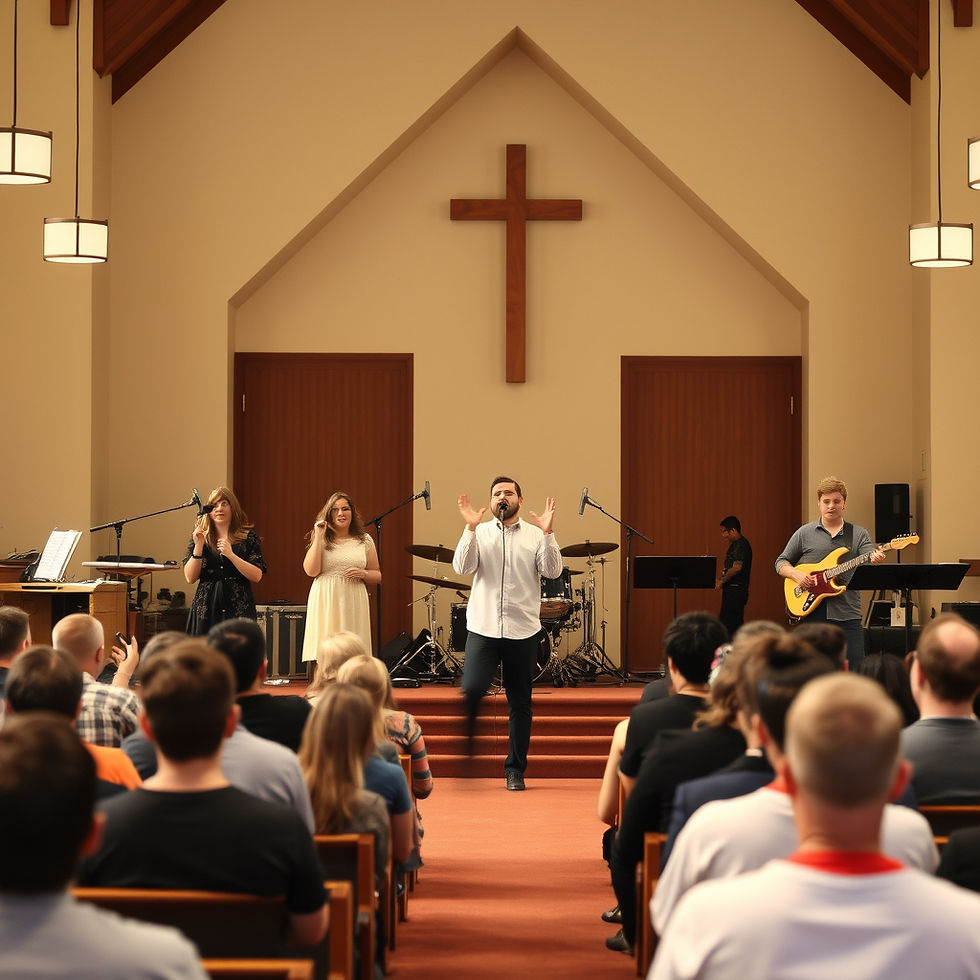
Then, the band kicks in. And within four minutes of emotional, atmospheric synth pads and driving kick drums, the entire congregation is singing:
“Till on that cross as Jesus died, the wrath of God was satisfied.”
In an instant, thirty minutes of intentional pastoral care and nuanced theology are overwritten by an arena-rock hook. Because here is the undeniable truth of church life: people rarely leave church humming the sermon, but they will sing the chorus all week long.
Music is our most powerful form of liturgy. It bypasses our cognitive filters, burrows deep into our subconscious, and shapes our functional image of God far more effectively than any theological treatise. If we as progressive Christians care about the spiritual formation of our communities, we must critically examine the theology packed inside Contemporary Worship Music (CWM) - and ask ourselves whether we are formed by the radical call to follow Jesus, or merely lulled into an emotional performance of praising Him.
1. The Shift: Praise Him or Follow Him?
One of the most fundamental shifts in contemporary praise culture is the transition from discipleship to devotional consumerism.
Jesus rarely asked anyone to worship Him. His persistent invitation across the Gospels was simple and demanding: “Follow me.” He invited people to walk in His way, embody His ethics, feed the hungry, welcome the outcast, challenge imperial power, and practice radical nonviolence.
Yet, the vast landscape of CWM has transformed Jesus into an object of romanticized adoration rather than an exemplar of justice. The lyrics frequently treat Jesus as a celestial boyfriend - focusing almost entirely on personal feelings, intimacy, and individual salvation. In this framing, Christianity becomes a private, emotional refuge rather than a public, ethical call to transform the world. When worship becomes solely about how Jesus makes me feel, we lose the radical, destabilizing call of the Gospel.
2. Toxic Theologies Encoded in Modern Lyrics
Beyond the distraction of individual-centered praise, modern worship lyrics frequently carry harmful theological assumptions that run counter to progressive Christian thought:
A. Penal Substitutionary Atonement & Divine Violence
Popular anthems often depict God as a cosmic tyrant whose wrath requires the brutal execution of His own Son to restore cosmic order. This theology presents a deeply broken picture of God - one where love is contingent upon violent payment. It conditions believers to accept violence and retribution as divine principles. This is not generally a theology preached from progressive pulpits, so it doesn't have a place in our music either.
B. "Worm Theology" & Innate Depravity
Generations of worshipers have been conditioned to sing about their inherent worthlessness - labeling themselves as "worms," "dirt," "saved a wretch like me," or "broken beyond repair." Progressive theology asserts that our foundational reality is original goodness, not original depravity. We are made in the image of God (Imago Dei). While we are imperfect and in need of healing, telling people they are inherently worthless inflicts deep spiritual and psychological harm.
C. Imperial Militarism & Spiritual Warfare
The obsession with military imagery - "marching armies," "taking ground," "conquering nations," and "destroying enemies" - mirrors earthly imperialism rather than the Christ who refused the sword. This language subtly aligns the church with nationalistic power and frames our neighbors as combatants rather than brothers and sisters. And this is especially dangerous in the face of the rise of Christian Nationalism.
D. Hyper-Individualism ("Me-and-Jesus")
Countless modern songs use first-person singular pronouns ("I", "me", "my") almost exclusively. The biblical tradition is overwhelmingly communal - centered on "us," "we," and the collective healing of creation. When worship isolates us into individual pods of personal piety, we forget our solidarity with the poor, the oppressed, and the planet.
3. Why Pastoral Vigilance Matters
Pastors cannot afford to treat music selection as a passive background task delegated entirely to a worship leader's musical taste. To do so is to surrender the primary vehicle of spiritual formation in your church.
Pastoral vigilance is not about playing theological dictator or micromanaging playlist choices. It is about treating worship leaders as co-theologians. We must invite our musical directors into the pastoral work of liturgy, helping them understand that every song we put on the lips of our congregation is a prayer that shapes their souls.
4. Simple Lyric Modifications: Reclaiming the Songs We Love
You don't always have to throw out every beloved melody. Many contemporary songs have gorgeous arrangements and powerful emotional resonance. With a few thoughtful, intentional lyric adjustments, we can repurpose familiar tunes to align with an expansive, loving theology:
Original Lyric | Progressive Modification | Theological Shift |
“Till on that cross as Jesus died, the wrath of God was satisfied” | “Till on that cross as Jesus died, the love of God was magnified” | Shifts from divine anger & retribution to unconditional, self-giving love. |
“I couldn't earn it, and I don't deserve it” | “I couldn't earn it, but You say I'm worth it” | Shifts from toxic self - loathing to affirming inherent human dignity. |
“Nothing but the blood of Jesus” | “Nothing but the love of Jesus” | Shifts focus from transactional blood sacrifice to healing grace. |
“My debt is paid” | “My debt erased” | Shifts from a rigid, penal-legal arrangement to relational mercy. |
Alternative Progressive Artists to Explore
If you want to introduce songs built from the ground up on justice, inclusion, and expansive grace, consider bringing these artists into your congregation's repertoire:
The Porter's Gate: Focuses specifically on justice, mental health, climate, and labor through liturgical art.
Common Hymnal: A collaborative network of Black, Brown, and progressive artists combining praise and protest.
The Brilliance: Acoustic/orchestral band built around nonviolence, refugee advocacy, and peace-building.
Flamy Grant: Folk-pop artist writing deconstructive, healing anthems for survivors of spiritual abuse and purity culture.
Audrey Assad: Contemplative, expansive worship focusing on nonviolent atonement and inner restoration.
5. Welcome, Hospitality, and the Harm of Familiar Language
This brings us to a crucial pastoral question: Is there space in a progressive church to welcome people from conservative, traditional backgrounds by using the language - and not just the musical style - they know and love? How much harm does it do?
This requires deep pastoral nuance.
The Case for Shared Language
People leaving rigid, conservative, or fundamentalist environments are often undergoing painful theological transitions. When they step into a progressive sanctuary, hearing familiar tunes or traditional vocabulary (like grace, redemption, salvation, Lord) can provide an emotional landing pad. It signals that they haven't abandoned their faith, but are finding a safer, wider room to live it out. Language can act as a bridge, helping newcomers feel oriented rather than instantly alienated by unfamiliar jargon.
The Real Potential for Harm
However, we must also recognize that many people sitting in progressive pews are survivors of spiritual abuse, purity culture, homophobia, and hellfire theology. For them, uncritical triggers embedded in traditional lyrics - particularly around blood sacrifice, innate depravity, and divine judgment - are not comforting; they are traumatic.
When a progressive church uncritically sings songs encoded with punitive theology, we create severe cognitive dissonance. We undermine our own credibility and risk re - traumatizing those who sought sanctuary in our communities specifically to heal from those exact ideas.
The Pastoral Path Forward: Style Over Toxicity
The solution is not to create an elitist, sterile environment where only modern academic language is allowed. The pastoral path forward lies in distinguishing musical style from theological toxicity:
Adopt the Style, Filter the Substance: You can keep the soaring electric guitars, atmospheric synths, and driving acoustic rhythms that people connect with emotionally, while holding a firm, loving boundary against theologically unaligned lyrics.
Contextualize and Reframe: When using older hymns or traditional phrasing, take thirty seconds before the song to frame it. Offer a brief reflection: “As we sing these historical words today, we remember the poetry of our ancestors, reinterpreting their search for grace through the lens of God's limitless love.”
Focus on Hospitable Expansion: Teach your congregation that our language for God must expand, not shrink. Balance traditional imagery with feminine, neutral, and expansive images of the divine.
Conclusion: Singing a Better World into Being
Worship music is not neutral soundtrack material - it is a spiritual ecosystem. As progressive pastors, our goal is not to police art, but to curate a worship experience that heals rather than harms, that inspires action rather than apathy, and that points beyond mere emotional performance to the radical, transforming way of Jesus.
Let us lead our churches in singing a liturgy that matches our preaching: a song of belonging, inherent worth, restorative justice, and endless grace.


Comments