A Heart Wide Open: Choosing the Third Way

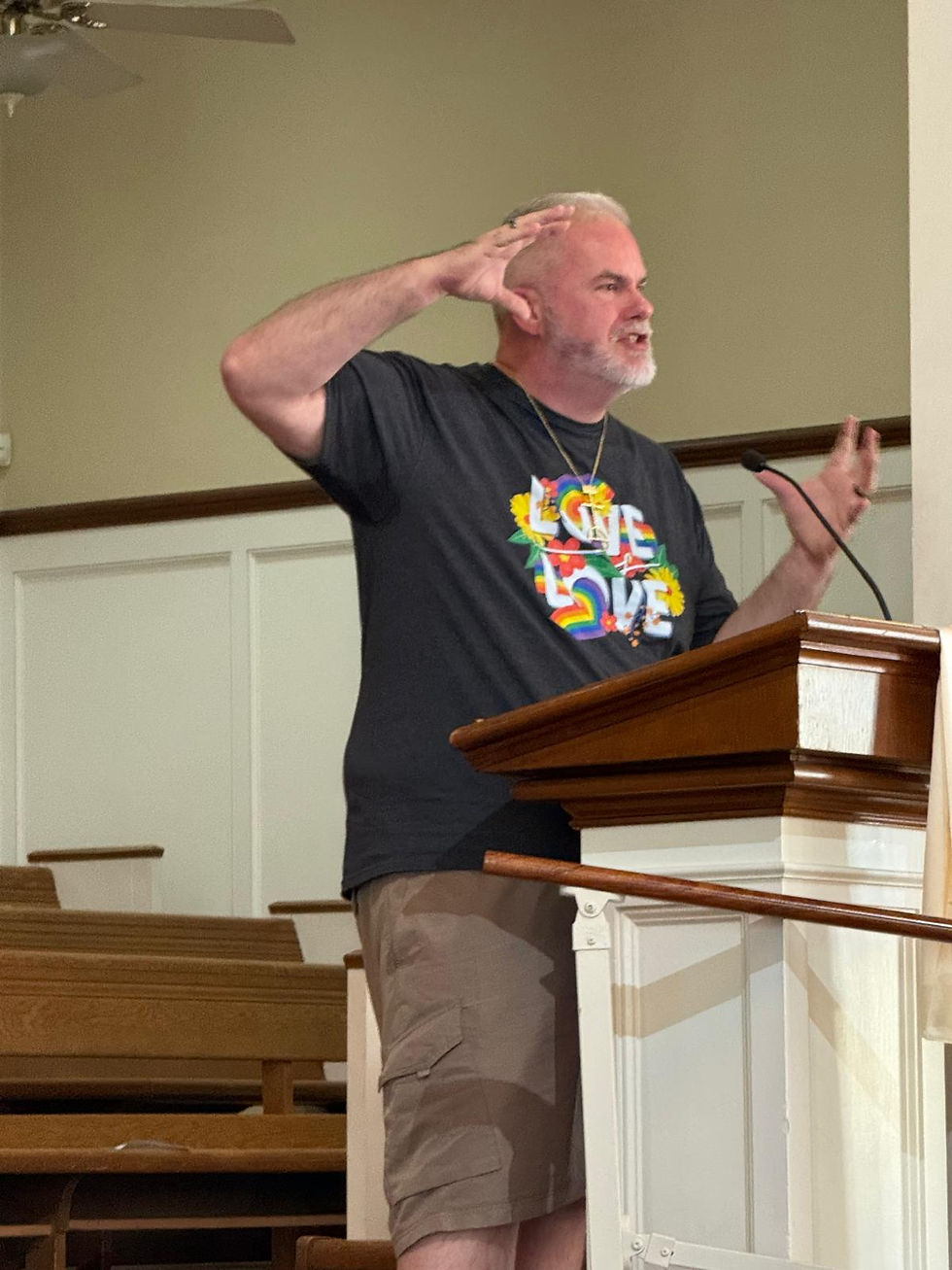
Delivered at First Church Phoenix UCC, June 28, 2026
Open & Affirming / Pride Sunday
Introduction: The Desert and the Wall
Good morning, beloved family of First Church Phoenix. It’s a blessing to be back with you again, especially during the national celebration of Gay Pride Month and the UCC’s celebration of Open & Affirming Sunday today! I’m so grateful for your ongoing witness for justice and inclusion in this church and out in the world! Your witness and care of our queer siblings transforms lives and is truly the work that Jesus gave us to draw the circle wider for all God’s beloved children, so THANK YOU!
Will you pray with me?
Glorious and wonderful God, you are a God of infinite possibility, a God of wild inspiration, and a God who blesses us with a sacred creativity that expands far beyond the artificial boundaries that exist in our lives.
Holy One, I pray that you would enable us to hear a word afresh for us this day - a word that invites us beyond the narrow, suffocating binaries we often believe to be true, but in fact are not - so that we, in our own lives' experience, may step into your spaciousness and reflect that glory into the world.
So now, God, I pray that you would be present in this space, that you shape the words that come from my mouth and how we hear and understand them, that we may live our lives just a little more fully and a little more in line with the magnificent creatures you made each of us to be. I pray this in the name of the one I know as Jesus, the Christ, and in the many names we know you by in our hearts, Amen.
The Witness of the Sonoran Desert
Friends, if you step outside our sanctuary doors today and you look out toward the vast expanses of our Sonoran Desert, you will notice something beautiful: The desert simply refuses to be contained or defined. Nature abhors a straight line, and plants grow and flower in every nook and cranny, and an infinite array of God's children fly, crawl, and dig their way across its terrain.
I remember my very first family trip to Arizona when I was 11 years old. This naive little boy from Iowa was deeply disappointed when I stepped off the plane at Sky Harbor and didn't walk directly onto the blowing sands of the Sahara desert I had expected. I remember wondering why there were no camels walking the streets. My immature mind imagined a strict binary of green and lush vs. barren and lifeless.
But after you spend any amount of time in our beautiful desert, you know that Arizona lives somewhere in between those two extremes. It refuses to be defined by binaries. It represents a Third Way that couldn’t be captured by my 11-year-old mind until I saw it with my own eyes.
After living here for seven years and experiencing not only the scorching, dry summer heat but also the sometimes violent summer monsoon rains, I learned that nature here has a way of continuously surprising us. And I learned that the diversity of our climate wears down any barrier. Mountains are slowly eroded away by the wind and rain, flowing waters cut deep valleys and even Grand Canyons into the rock, and tumbleweeds blow freely across vast, unfenced expanses of land.
The Illusion of the Binary
In a landscape this expansive, suddenly coming upon a wall seems incredibly out of place. It goes against the very spirit of the land.
Nevertheless, we live in a world and a culture obsessed with erecting barriers. We build massive, rigid walls designed to force a complex, fluid world into two simple categories: us on this side, them on that side. Safe here, dangerous there. And of course, in 2026, we see this nowhere more clearly than at our southern border.
But the desert doesn't cooperate with our divisions. The monsoon rains carve giant paths right through human-built barriers, and both the desert bighorn sheep and our neighbors from the south find the gaps and come right through. The desert doesn't care about our walls. It lives in what some spiritual teachers call the Third Way - a thriving, breathing third thing that is neither one side nor the other, but a delicate, undivided web of relationship where everything is connected, and everything belongs.
And yet, from the moment we draw our first breath, our culture tries to force us behind walls and into binary boxes. We are handed the blue blanket or the pink blanket. We are sorted:
male or female
insider or outsider
straight or queer
cisgender or trans
white or (well, let’s just say “not white”)
productive or useless
normal or broken
These boxes are not just neutral descriptions. They are tools of control. They are designed to flatten the wild, shimmering complexity of who you are into something predictable and manageable. Because if the world can categorize you, it can keep you quiet. If it can keep you in your assigned box, it can ensure you never realize just how free you are actually meant to be.
Shattering the Boxes: Paul’s Radical Word
But today, on this Pride Sunday, we gather to hear a different word. We gather to listen to a radical whisper of ancient defiance that has survived all the twists and turns and biblical translations of history to reach us here in the desert on this very morning.
Hear these familiar, revolutionary words from the Apostle Paul’s letter to the Galatians:
"There is no longer Jew or Greek, there is no longer slave or free, there is no longer male and female; for all of you are one in Christ Jesus."
Now, for a long time, the Church has read this verse as a sweet, polite statement of "inclusion" - as if Paul were simply saying, "Everyone is allowed in the building now."
But make no mistake: Paul's words are not a polite invitation to sit in the existing pews. They are theological dynamite.Paul is not saying we are welcome to squeeze ourselves into the old boxes; he is saying the boxes themselves have been shattered. He is declaring that in God’s eyes, the rigid divisions we build to establish our identities and protect our egos are completely obsolete.
And this is where the quiet miracle of Pride comes in. When we as LGBTQIA+ people live openly, authentically, and courageously outside the boundaries, we are doing something far more profound and subversive than just surviving. We are holding open a portal of liberation for everyone else. By refusing to shrink into the binary shapes cut out for us, we show everyone that the rules we all thought were set in stone are actually negotiable.
And in doing so, we provide a sacred invitation to all, regardless of who you love or how you identify, to step out of the boxes and into the spaciousness and infinite creativity of the desert. Today, we as queer people invite you to look closely at the rigid scripts running your own lives and ask: Do these expectations, these binaries of behavior, actually serve your flourishing? Or do they just serve your conformity and your safety?
The Human Struggle with the Wall
But let’s start out by being honest: living outside the boxes can be terrifying, especially at first. I remember my own coming out struggle as a 14-year old boy in Des Moines, IA. I wanted so desperately to be my authentic self! But my fear of losing the love and safety of my family by coming out of the closet was so pervasive that it would take me another decade to fully own who I was. And once I had, I could never go back. Even today, faced with similar questions of living authentically vs. claiming the safety of the binary, I will always choose for authenticity, no matter how much fear I feel. Because thankfully, my closet has shrunk to such an absurdly small size that it's physically impossible for me to fit back inside - and let me tell you, I have no intention of trying!
But even so, the gravity of the binary is incredibly strong, and history shows us just how easily we can slide back into building walls when we get scared.
We even see this struggle in our own scriptures. While Paul wrote those radical, liberating words in his very first letter to the Galatians, later letters - like Ephesians and Colossians - tell a different story. Most biblical scholars suggest that these later letters were written by Paul's disciples, writing in his name generations later. Under the claustrophobic pressure of the Roman imperium, they were desperately trying to keep their fragile home churches from being crushed as political subversives, so these later writers went back into the closet and put the lid right back on the boxes.
To appease the Roman Empire, they introduced the "household codes," arguing that women must submit to men, and slaves must submit to their masters. They retreated from Paul's radical, undivided vision in Galatians to signal to Rome that Christians were not social anarchists.
I find a strange comfort in this historical struggle. It reminds us that the boxes imposed on us by Empire are real, heavy, and terrifyingly strong. When survival is at stake, those forces act like a center of gravity - pulling us to compromise our deepest ideals and hide our true identities just to stay safe.
The Power of Introjection
In psychology, there is a specific, powerful term for how these external forces slip past our defenses and colonize our inner lives. It is called introjection.
Think of introjection as swallowing a large piece of food completely whole - without chewing it, tasting it, or digesting it. When we introject, we gulp down the world's rigid rules, societal expectations, and artificial binaries in one single, choke-inducing swallow. We do not chew on them to see if they make sense; we do not digest them to see if they actually nourish our souls. Instead, we carry them heavy, cold, and fully intact in our guts, rebuilding those concrete walls inside our own psyches. We do not just live in a boxed-in society; we introject the boxes themselves, allowing them to police our thoughts, our desires, and our self-worth.
Following society’s rules is a natural survival instinct, and staying safe matters. But breaking free from the crushing weight of those expectations is one of the greatest strengths of the LGBTQIA+ community. It takes immense courage to resist the pressure to conform and instead live as our authentic selves. Even after we come out, living that truth remains a daily, courageous labor of love.
Three Guides for the Wilderness
So how do we all break out of these cages? How do we find the courage to live in the spaciousness of the desert? How do we navigate this "Third Way"?
If you were in church last week, or like me, worshiped online, you heard the beautiful prayer at the end of the service that captures the very heart of what we aspire to:
"May we move beyond either-or into the spaciousness of wonder, where mystery is welcomed, possibilities expand, and creativity is awakened."
That is the spaciousness of the Third Way. It is not a wishy-washy compromise. It is not about standing in the middle of a highway trying to please everyone. It is a radical refusal to play the game of "either-or" entirely.
To help us navigate this, let us look to three spiritual guides who spent their lives mapping this wilderness.
1. Thomas Merton
Our first guide is Thomas Merton. Thomas was a Trappist monk who spent decades living in a silent, highly structured monastery in Kentucky. He knew all about rigid, Catholic boxes. But on one spring afternoon in 1958, he found himself standing on a busy street corner in downtown Louisville, at the intersection of Fourth and Walnut.
As he stood there, watching ordinary shoppers, business people, and children rushing by, something inside him cracked wide open. He didn't see "sinners" or "outsiders." He was suddenly overwhelmed by a fierce, staggering love for every single stranger walking past. He realized that the separation he had built between his "holy" monastic life and their "secular" lives was a total illusion.
He wrote:
"It was like waking from a dream of separateness... I realized that we are all members of a race in which God Himself became incarnate."
Thomas saw that the ultimate spiritual task is to escape the dualistic prison of our own ego-constructed walls and wake up to the total, unbreakable oneness of God's family.
2. Richard Rohr
Our second guide is Richard Rohr, a Franciscan priest who spent his life translating Merton’s ideas for ordinary seekers. Father Richard teaches that our human minds are biologically wired like simple, binary computers. We process information as zeros or ones, good or bad, correct or incorrect, safe or dangerous.
This "computer mind" is highly efficient for basic survival. If you're running from a mountain lion in the desert, you don't need a contemplative pause; you need a binary reaction! But Father Richard warns us that this binary mind is completely, utterly inadequate for dealing with mystery, suffering, grief, and above all, love. To live a deeply human life, we have to move into what he calls "non-dual consciousness." We have to learn to step out of our binary computers and open our hearts to the expansive, spacious path of Both/And.
3. Cynthia Bourgeault
Our third guide is Cynthia Bourgeault, a modern mystic who takes this path and applies it to our everyday conflicts. Cynthia uses a beautiful, simple image called the Law of Three. She asks us to imagine a relentless game of tug-of-war between three forces:
Force 1 - the push, the stance, the "I am right" side.
Force 2 - the pull, the resistance, the "no, you are wrong" side.
In our culture, we believe these are our only two choices. We pull and we pull, believing that if we just pull hard enough, our side will win and everything will be okay. But Cynthia teaches that as long as we stay on that rope, nothing new can ever be born.
She introduces Force 3 - the Reconciling Force. This is the Third Way. It is not a weak compromise where both sides agree to get a little bit of what they want. It is the courage to drop the rope. It is the willingness to stand in the tension of opposites with an open, quiet heart, waiting for a brand-new possibility to emerge - a possibility we couldn't have even imagined when we were busy fighting.
Dropping the Rope: How We Live This
If you want to see what this relentless tug-of-war looks like in real life, you don't have to look any further than our current political landscape.
Right now, American politics is completely trapped in a toxic, exhausting game of binary pull. On one side of the rope, we have Force 1 - the Left - representing evolution, progress, and inclusion. On the other side, we have Force 2 - the Right - representing continuity, structure, and tradition.
We are told that we must choose a side and pull with all our might, hoping to pull the other side into the mud. But applying the Third Way here does not mean advocating for lukewarm moderation, apathy, or a centrist compromise that pleases no one. Dropping the rope is not passive; it is a highly active, disruptive, and creative transcendence. It is the refusal to let the terms of the empire define how we engage. It is a radical, active refusal to dehumanize the person holding the other end of the rope.
The political Third Way recognizes that both progressivism and conservatism are holding onto vital, partial truths: we need change to grow, and we need structure to survive. Instead of mutual destruction, the Third Way has the courage to hold the agonizing tension between these two necessary values, waiting in the discomfort until a brand-new, higher-order political imagination can manifest - one that looks less like a battleground and more like an open desert where everyone can flourish.
This is exactly how Jesus lived. Every time the religious authorities tried to trap him in a binary - "Should we pay taxes to Caesar or not?", "This person was caught in a sin; do we stone her or let her go?" - Jesus refused the trap. He didn't take the bait. He didn't choose a side on their rope. He dropped it. He drew in the dirt, he asked a deeper question, and he shifted the entire conversation toward compassion. He didn't split the difference; he transcended the category.
And this is the deep, spiritual gift of Pride.
In truth, queer people are modern pioneers of this Third Way. Whether it is breaking the boundaries of binary sexuality, gender identity, relationship structures, or pushing the edges of fashion, art, and music - as outsiders who could not even be spoken of in polite company for centuries, queer people have always had to create our own rules. By resisting the normative binaries of society, we free ourselves to live aligned to God's expansive plan for each one of us. And that is an opportunity that each and every one of us can experience in our own lives.
Conclusion: Intention, Resistance, and Joy
This is not a lesson meant only for some of us. This is a saving grace offered to all of us.
And so, on this Pride Sunday, let us say a deep, heartfelt, and fiercely grateful "thank you" to our LGBTQIA+ siblings. Thank you for your courage. Thank you for surviving the crushing weight of the world's categories, and thank you for showing us what it looks like to live in the wild, creative freedom of the Holy Spirit. You have shown us that life outside the lines is not a place of exile, but the very soil where God speaks. It is the place where we find what we call Queer Joy.
Let us leave this sanctuary today committed to the beautiful, subversive work of "queering" our own lives - of refusing to let the old, rigid scripts write our stories. Let us do so with clear intention, with steady resistance to the boxes, and above all, with an unshakeable, revolutionary joy that is everyone’s birthright. And let us prepare that birthright for the next generation, so it is even easier for them to live without closets and binaries of any kind.
The Holy Spirit is breathing on our boxes today. Whenever we draw a line to keep someone out, or whenever we build a wall to keep ourselves safely tucked in, God is already standing on the other side, looking back at us, and whispering:
“Come on over! Life is good over here!”
First Church Phoenix United Church of Christ, May it be so. Amen.

Comments