Sermon: The Tie That Binds - The Power of Covenant in a Divided World

Updated: Apr 27
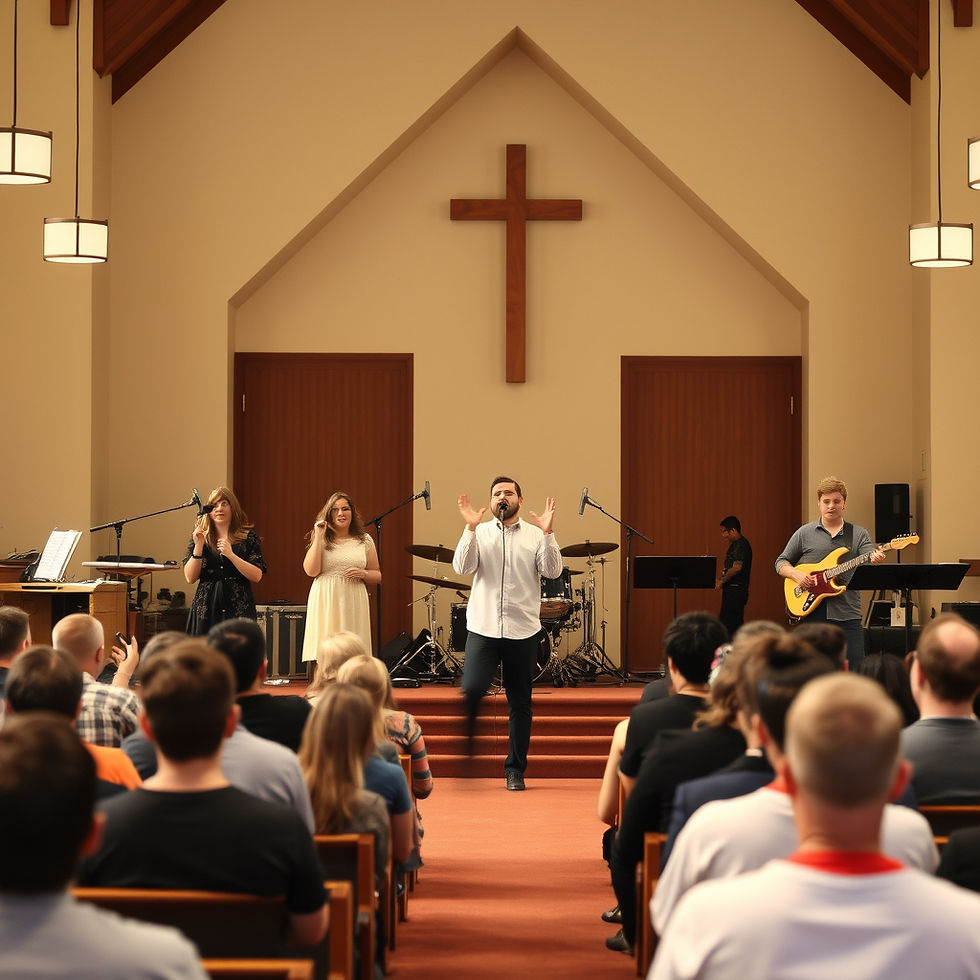
Worship leadership and sermon at First Church Phoenix UCC on April 26, 2026.
Scripture Base: Jeremiah 31:31-34 and 1 Corinthians 12:12-27
Introduction: The Invisible Thread
Friends, seekers, and members of this beautiful First Church family - today we are talking about the very thing that holds the walls of this sanctuary up. I don’t mean the literal stone, the desert-baked wood, or the mortar that Omah, Max and the team here so faithfully maintain. I am talking about the invisible thread that weaves us into the beautiful, complex tapestry we are. In the United Church of Christ, we call it Covenant.
In our secular world, our lives are ruled by contracts. A contract says, "I will do this for you if you do that for me." It is a transaction of self-interest, protected by fine print and legal penalties. Contracts are built on a foundation of mutual suspicion - we sign them because we aren't entirely sure we can trust the other party. We need a "recourse" if things go wrong.
But a Covenant? A covenant is a transaction of the soul. It is not a deal; it is a destiny. It is a promise to stay at the table even when the conversation gets difficult, even when the "return on investment" isn't immediately clear. And in our denomination, The United Church of Christ, It is the foundation of our church family. And as we look at the fractures in the church, our city, and our nation today, I would argue that Covenant is the only thing that can save civilization itself. Because a society built only on contracts eventually eats itself when the "deals" stop being profitable. Only a covenantal society has the resilience to survive the lean years and include EVERYONE, not just those who are perceived by and unforgiving and greedy society to bring “value to the table”.
Let’s look at it this way - if marriage and long-term partnership were merely contracts, most of us would have been sued for breach of agreement within the first forty-eight hours. If we operated purely on a contract basis, every kitchen would need a legal department. You’d find yourself saying, "According to Section 4, Paragraph B of the Tuesday Night Agreement, I have fulfilled my obligation to load the dishwasher, and therefore your failure to wipe the counter constitutes a material default."
But thank God, our most sacred bonds are built on Covenant. Covenant is what happens when you look at the person who just forgot the grocery list for the third time and say, "I am still here." It is the grace that realizes the ledger might be broken, but the love is whole. A covenantal relationship means moving from "What have you done for me lately?" to "I am here for you, even when things are hard." It means being a "safe harbor" for the secrets and the shames of those we love. Covenantal love isn't about fulfilling a simple functional role in someone else's life; it is about the radical commitment to the growth and wholeness of the other, honoring the unique and sacred bonds that connect us as we navigate the complexities of life and our very real differences of identity and perspective together.
The Pilgrim Path: Why Covenant Defines Us
To understand why this word "Covenant" matters so much to us in the United Church of Christ, we have to look back at our history. We are the spiritual descendants of the Pilgrims and the Puritans - people who crossed an ocean not just for "freedom," but for the right to be in covenant with one another.
In the 1600s, most people lived under "Contract Religion." You were a member of the state church because you had to be. Faith was a legal obligation. But our ancestors believed in a "Still-Speaking God." Before the Pilgrims left for the New World, their pastor, John Robinson, gave them a famous charge. He told them that "the Lord has yet more light and truth to break forth from his holy Word."
Because they believed God was still speaking, they couldn't be bound by a rigid, unchanging creed imposed by a church that was bound to Empire. Instead, they formed "Covenantal" communities. They signed church covenants where they promised to "walk together in all God’s ways, made known or to be made known to them."
This is our DNA. It is why we are a non-creedal church. We don't ask you to sign a contract of belief; we ask you to enter a covenant of relationship. This heritage reminds us that our faith is a journey - and the only way to navigate a journey where the "light" is still breaking forth is to be bound to one another by love rather than bound to a document based on dogma and control.
The Old Testament: The Seduction of the Golden Calf
Now let’s look even further back to our spiritual ancestors. In our reading from Jeremiah, the prophet is speaking to a people sitting in the rubble of what they once knew. They had a covenant with God and with one another - a promise to care for the vulnerable and to walk in the ways of justice.
But over time, they fell out of it. And it’s important to understand how they fell out of it. They didn't wake up one morning and decide to be "evil." They simply became afraid. And when we are afraid, we trade our covenants for control.
Think back to the story of the Golden Calf. While Moses was up on the mountain, the people got nervous. They didn't want a "living God" who moved in the wind and called them to a covenant of faith; they wanted a god they could see, touch, and command. They wanted a god that served their national identity. They traded the relational mystery of God for a political tool. They prioritized the "I" over the "We" because they felt their safety was at stake.
Is any of this sounding familiar to you?
The Breach Today: The Fear of the Troubled Heart
Here is where we must speak truth in our own time. We see this ancient tragedy repeating itself in the rise of white Christian Nationalism. If we look closely, we see the symptoms of a profoundly troubled heart.
When we see movements that use faith as a tool for exclusion, we are seeing the behavior of people who are deeply afraid. They are afraid of change. They are afraid of no longer being the dominant force in society. They are afraid of neighbors who speak languages they didn't grow up with or who hold beliefs they don't understand - and honestly, don't want to.
When the heart is troubled by this kind of fear, it stops being able to read the Covenant God wrote there - the Covenant that tells us to love the stranger as ourselves. Instead, fear turns the heart toward a "Power-Contract." It is a seductive logic that whispers: "If we can just codify our own comfort into the law, if we can just marginalize the parts of the Body that challenge us, then we will finally be secure." It trades the vulnerability of relationship for the cold certainty of control.
But this is a lie. You cannot find safety by breaking the Body of Christ. When religion is used to strip away the rights of the marginalized, we are seeing a people who have replaced the "heart-covenant" of love with a "power-contract" of domination. And when the Gospel starts spilling from their lips, it sounds performative, foreign, and wrong. And I don't know about you, but I feel like we have been hearing that a lot lately, haven't we?
The New Covenant: Repairing the Fear
Jeremiah promised a day when the covenant wouldn't be on stone tablets but written on the heart. God’s response to our fear is not to give us more rules or more power, but to remind us of our original connection to the divine and to one another.
When we return to Covenant, we begin to trust again. We find the common bonds that bring us together - not as a divided, tribal people, but as the beloved children of the Divine. Covenant is the only thing that can repair the fear - for it is an architecture of grace far more durable than the fragile walls our anxieties build. It allows us to look at the person we were taught to fear and see instead a member of our own family. It allows us to see the Imago Dei - the image of God - in one another, exactly as God intended - as a single human family.
The ink God uses is permanent. Even when a heart is so troubled by fear that it forgets the Covenant and lashes out, the writing is still there, waiting to be rediscovered. To love God, to love neighbor, and to love self - this is the only reality that can sustain us when the "Golden Calves" of political power inevitably crumble. And crumble they shall!
The Anatomy of Interdependence: From Phoenix to the Stars
This is why we need to lean so heavily into the incredible imagery that Paul offers to the troubled Christian community in Corinth that had lost their way. Paul reminds us that we are the Body of Christ. If one heart is too troubled to remember the Covenant, the rest of the Body must hold that memory for them.
Think about the biology. If you cut your finger, the whole body redirects resources to heal that one small part. The body knows that if the finger is suffering, the whole person is limited. Paul says, "The eye cannot say to the hand, ‘I have no need of you.’"
But how far does this interdependence go? How "different" can a part of the body be before we decide it doesn't belong?
I am reminded of the story Project Hail Mary. In it, a man named Ryland Grace is sent on a mission to save humankind from a dying sun. He wakes up in deep space only to find he is not alone. He encounters Rocky - an alien from another planet. Rocky couldn't be more different. He looks like a five-legged rock, he breathes ammonia, and he communicates through musical chords.
Initially, there is fear. There is a tentative "Contract" of survival they form together. But as they work together and get to know one another, something shifts. They move from "suspicious strangers" to "Covenant partners." They realize their survival is inextricably linked, which in this story is literally true.
Ryland Grace begins as a reluctant hero - someone who just wanted to survive for as long as he could. But by the end, he understands that Covenant is so foundational to existence that it spans the entire galaxy. He realizes that "God's wider creation" includes even the most "alien" other. His commitment to Rocky brings both joy and sacrifice. He chooses the well-being of his friend over his own comfort, proving that the Body of Christ is not just a human metaphor - it is a law of love that spans the entire universe.
Implementing Covenant: Mending the World
So, how do we move from being "Contract People" to "Covenant People"?
In Our Church: Sacred Listening and Holy Truth
Here at First Church Phoenix, we live this out through our Covenantal Polity. In the United Church of Christ, we often define covenant as "the solemn and binding agreement of God's people to walk together in all God’s ways, according to the Gospel."
But our covenantal way of relating often means being willing to address situations that are very uncomfortable. Covenantal listening is not always soothing. Sometimes, it requires us to open ourselves up to difficult truths - truths that call us to task for not behaving the way that perhaps we should have. And often it requires us listening to the experience of another that is so foreign to our own, that we can make the mistake of questioning its validity, even though it is not an experience we ourselves have lived.
In a contract, if you call me out, I might look for a way to cancel the agreement. In a Covenant, I am bound to stay and hear the truth of your experience. It means listening when a sibling in Christ says, "Your words hurt me," or "Your silence in the face of injustice is a breach of our covenental promise." This is the hard, gritty work of telling compassionate truths, taking the lived experience of others and face value, and mending broken relationships.
However, we also fall out of covenant in the quiet spaces. We fall out of covenant when we are silent in the face of conflict, or when we feel disconnected but don't reach out. Simply ignoring the covenantal obligations because they are inconvenient or awkward is just as much a breach as overtly acting contrary to covenant. When expectations aren't being met and we choose to remain silent rather than stay at the table, we risk doing permanent damage to the threads of our collective tapestry. Covenant is not a finished document; it is a living relationship. Quiet neglect can be just as devastating as a loud conflict. It is far better to do the hard work of reconciliation today than to wait until someone feels so invisible that they simply leave the Body behind.
The Turning Tide: A Moment of Radical Grace
In recent weeks, we have seen things that feel like a shift in the atmosphere. We have seen people who we might have once classified as "evil" - yes, Tucker Carlson, I am talking to you - seemingly begin to repent of their past support for the fires of Christian Nationalism. Social media is alive with voices starting to recognize the ungodliness of Empire. It is as if the covenant in their hearts is starting to reawaken because the stench of exclusion and domination has become so strong that even those who were stoking its fires can no longer stand the smell.
But this is a critical moment in the covenental life of our nation as those we might have rejected from our lives come to this realization. We can either reject them for their past "sins", or we can demonstrate the abundant grace of God by welcoming them back to our shared covenant. This may be the very moment we have been hoping for - the moment when those who have separated themselves from the body of Christ finally find their way home.
It starts by listening to them first. Not to validate their fear, but to acknowledge their humanity. When we belittle or deride those who are acting out of fear, we are simply signing a contract of mutual contempt. To stay in covenant, we must resist the urge to dehumanize the dehumanizer. We must welcome them back by remembering that Christ died for them as much as He died for us.
Now, I don't want to risk oversimplifying the message here. In covenant, there is also accountability, and justice remains an important concept in our faith. We are called to prevent and interrupt harm wherever we can. The truth of the harm that has been done by this administration must never be forgotten. But those who acknowledge their willful abandonment of the body of Christ and wish to rejoin it with a pure heart must be welcomed back into the fold, the same way Jesus embraced the tax collector. It is not our job to gatekeep those who sincerely wish to be part of our covenant.
Conclusion: The Challenge of the Menders
Church, we have traveled a long way today - from the Pilgrim ships to the rubble of Jerusalem, and out into the deep space of the stars. We have seen that Covenant is the architecture of the soul.
But Covenant is not a theory; it is a thread that must be tended. And so, I have a challenge for you today.
First, look inward at First Church Phoenix. Where have we allowed the thread to fray in the "quiet spaces"? I challenge you to speak difficult truths to one another and to address the unmet needs and broken covenants that have been lurking in the shadows. Don't let silence become the wedge that drives us apart. If you feel disconnected, reach out. If you feel a promise was broken, stay at the table and name it. Encourage one another to do this work, because we cannot be a "safe harbor" for the world if we are drifting apart within our own walls.
And as difficult as it may be, I also ask us to remember our covenant with all of God's people, even those who have separated themselves from the Body. The thing that most differentiates us from them must be our refusal to dehumanize them. We step into the gap. We weave the thread that invites them back into the fold of humanity. We listen. We get curious about how we can help them heal by offering them an alternative to their fear: God’s unconditional and boundless hope and love. Because the only alternative is to declare them to be lost to God - and in this church, we believe that is simply never true.
When this becomes difficult, or when your own heart is troubled, lean into this Body. Let this community remind you of the love that is carved into your soul, and then use that strength to offer it to others.
May the covenant we celebrate here today at First Church Phoenix be the fabric that mends the world tomorrow.
Amen.


Comments